
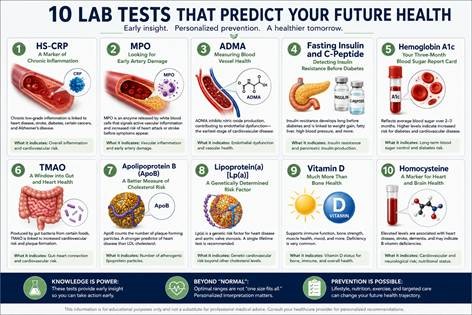
Looking Beyond “Normal” to Optimize Your Health By Elizabeth Acton Khan, MD Most people think of blood work as something you have once a year to make sure everything is “normal.” But what if your blood tests could reveal where your health is headed five, ten, or even twenty years from now? Many chronic diseases—including heart disease, diabetes, and cognitive decline—begin silently, long before symptoms develop. Advances in laboratory medicine now allow us to detect subtle changes early, giving us an opportunity to intervene through lifestyle changes and personalized care. Here are ten blood tests that provide valuable insight into your future health.
- High-Sensitivity C-Reactive Protein (hs-CRP)
A Marker of Chronic Inflammation Chronic low-grade inflammation is a major contributor to heart disease, stroke, diabetes, certain cancers, and Alzheimer’s disease—and it often goes unnoticed. Hs-CRP levels below 1 mg/L suggest lower cardiovascular risk, 1–3 mg/L indicates average risk, and above 3 mg/L suggests higher risk. Values above 10 mg/L may reflect an acute process and should be repeated. The 2025 American College of Cardiology now recommends universal hs-CRP screening, recognizing its prognostic value is comparable to blood pressure and cholesterol.
- Myeloperoxidase (MPO)
Looking for Early Artery Damage Heart disease often begins with inflammation inside artery walls rather than simply elevated cholesterol. MPO is an enzyme released by white blood cells that signals active vascular inflammation and may indicate increased risk of heart attack or stroke before symptoms appear. While MPO has shown predictive value, it has not proven superior to hs-CRP and is not as widely available in standardized formats. Vascular inflammation can often be improved through lifestyle modifications.
- ADMA (Asymmetric Dimethylarginine)
Measuring Blood Vessel Health ADMA inhibits nitric oxide production, contributing to endothelial dysfunction—the earliest stage of cardiovascular disease. A meta-analysis of over 30,000 individuals found elevated ADMA was associated with 52% increased all-cause mortality and 33% increased cardiovascular events. Elevated ADMA has been observed in hypertension, coronary artery disease, heart failure, stroke, kidney disease, and diabetes. ADMA is primarily used in research settings and specialized cardiovascular assessments rather than routine practice.
- Fasting Insulin and C-Peptide
Detecting Insulin Resistance Before Diabetes Blood sugar may remain normal for years while insulin levels rise—a condition called insulin resistance. It develops long before diabetes and is associated with weight gain, fatty liver disease, high blood pressure, metabolic syndrome, cardiovascular disease, and cognitive decline. Fasting insulin can identify metabolic dysfunction earlier than glucose testing alone. C-peptide, released in equal amounts to insulin, is most useful for distinguishing type 1 from type 2 diabetes and assessing residual insulin production. While the American Diabetes Association considers routine insulin testing primarily a research tool, fasting insulin can provide clinically meaningful information in a comprehensive metabolic assessment.
- Hemoglobin A1c
Your Three-Month Blood Sugar Report Card A1c reflects average blood sugar over two to three months. An A1c of 6.5% or higher diagnoses diabetes, while 5.7–6.4% identifies individuals at high risk—with a five-year diabetes risk of 25–50% for those between 6.0% and 6.5%. Even mildly elevated values have been linked to increased cardiovascular risk, and A1c is a stronger predictor of future diabetes and cardiovascular events than fasting glucose alone.
- TMAO (Trimethylamine N-Oxide)
A Window into Gut and Heart Health TMAO is produced when gut bacteria metabolize nutrients in red meat, egg yolks, and certain dairy products. In the Multi-Ethnic Study of Atherosclerosis (MESA), those in the highest TMAO quintile had a 33% increased cardiovascular risk compared to the lowest. TMAO may promote inflammation, impair cholesterol metabolism, enhance plaque formation, and increase platelet reactivity. TMAO highlights the connection between the gut microbiome and heart health. Note that kidney function influences TMAO levels, as the kidneys are responsible for clearing it from the blood.
- Apolipoprotein B (ApoB)
A Better Measure of Cholesterol Risk Each atherogenic lipoprotein particle (LDL, VLDL, Lp(a)) carries exactly one ApoB molecule, making ApoB a direct count of plaque-forming particles. The 2026 ACC/AHA Dyslipidemia Guidelines emphasize ApoB as more accurate than LDL cholesterol for cardiovascular risk, particularly in patients with diabetes, metabolic syndrome, or elevated triglycerides. In primary prevention studies, only ApoB remained significantly associated with heart attack when assessed alongside traditional lipid measures. ApoB is especially valuable when LDL cholesterol appears at goal but atherogenic particle number remains elevated.
- Lipoprotein(a) [Lp(a)]
A Genetically Determined Risk Factor Lp(a) is largely genetically determined and stable throughout life, so a single lifetime measurement is generally sufficient. It is now recognized as an independent, causal risk factor for atherosclerotic cardiovascular disease and aortic valve stenosis. Both the American Heart Association and European Atherosclerosis Society recommend measuring Lp(a) at least once in adults. Because Lp(a) is not significantly lowered by statins or lifestyle changes, identifying elevated levels is important for motivating aggressive management of other modifiable risk factors. Novel Lp(a)-lowering therapies are currently in clinical trials.
- Vitamin D
Much More Than Bone Health Vitamin D functions as a hormone supporting immune function, bone strength, muscle health, mood, and brain function. Deficiency is extremely common, even among individuals who spend time outdoors. While observational studies link low vitamin D to increased cardiovascular risk, large randomized trials have not demonstrated cardiovascular benefits from supplementation. Current evidence does not support vitamin D supplements specifically for heart disease prevention—but maintaining adequate levels remains important for bone health, immune function, and muscle strength.
- Homocysteine
A Marker for Heart and Brain Health Elevated homocysteine (generally above 15 µmol/L) has been associated with heart disease, stroke, dementia, and blood vessel damage. It may also indicate deficiencies in folate, vitamin B12, or vitamin B6. An important nuance: while elevated homocysteine predicts cardiovascular risk, B vitamin supplementation to lower it has generally not reduced cardiovascular events in trials. Homocysteine may be most useful as a risk marker and indicator of nutritional deficiency, though evidence supports that B vitamins may help prevent primary stroke and cognitive impairment. The Bigger Picture No single blood test can predict your future. But when evaluated together, these biomarkers provide a far more comprehensive picture of your health trajectory than routine testing alone. The goal is to identify subtle changes early enough to make meaningful improvements through nutrition, exercise, sleep, stress management, and, when appropriate, targeted medical therapy. Your blood is constantly telling the story of your health. Understanding that story may be one of the most valuable investments you can make in your future. This should be at the blog heading or with each blog This article is for informational purposes only and does not constitute medical advice. Consult your healthcare provider for personalized guidance.