
A major French study published in PLOS Medicine in 2024 has raised important questions about the safety of common food additives known as emulsifiers — and the findings deserve your attention. But they also deserve context.
What Are Emulsifiers?
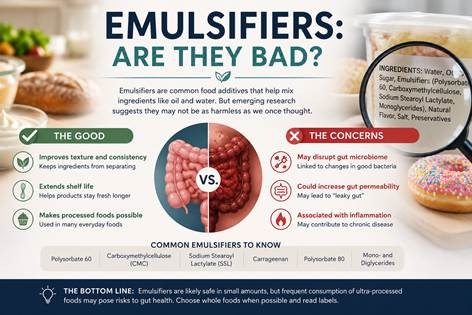
Emulsifiers are food additives used to improve texture, blend ingredients that don’t naturally mix (like oil and water), and extend shelf life. They’re found in a wide range of processed foods — from ice cream and margarine to plant-based milks and deli meats. If you’ve ever looked at a food label and seen ingredients like “mono- and diglycerides” or “carrageenan,” you’ve encountered emulsifiers.
The Study: NutriNet-Santé Cohort
Researchers from France analyzed data from approximately 92,000 cancer-free adults enrolled in the NutriNet-Santé prospective cohort study, following them for an average of nearly 7 years. Participants provided detailed dietary records that were linked to comprehensive food composition databases, allowing researchers to estimate their intake of specific food additive emulsifiers. During follow-up, 2,604 participants were diagnosed with cancer. After adjusting for numerous lifestyle and dietary factors, the researchers found statistically significant associations between certain emulsifiers and cancer risk: Mono- and diglycerides of fatty acids (E471) — commonly found in processed baked goods, margarine, and ice cream — were associated with:
- 15% higher risk of overall cancer
- 24% higher risk of breast cancer
- 46% higher risk of prostate cancer
Carrageenans (E407 and E407a) — thickening agents found in dairy alternatives, deli meats, and many plant-based products — were associated with:
- 32% higher risk of breast cancer
Notably, no association was found between any emulsifier studied and colorectal cancer.
Why This Matters — But Why You Shouldn’t Panic
These findings are significant because they represent the first large-scale human study to link specific food emulsifiers to cancer risk. Prior to this, concerns were based primarily on animal and laboratory research showing that emulsifiers can disrupt the gut microbiome and promote chronic low-grade inflammation — a known driver of cancer development. However, there are several important reasons to interpret these results with caution: Association does not equal causation. This was an observational study. People who consume more emulsifiers also tend to eat more ultra-processed foods overall, making it difficult to isolate the effect of any single additive. The researchers themselves acknowledged “possible exposure measurement errors” and “potential residual confounding.” The effect sizes are modest. A 15–46% increase in relative risk sounds alarming, but in absolute terms, the difference in cancer risk between the highest and lowest exposure groups is relatively small. This is one study from one population. The cohort was predominantly female (78.8%) and French. The authors explicitly stated that “these results need replication in other populations.” Regulatory bodies have reviewed carrageenan extensively. The European Food Safety Authority (EFSA) concluded in 2018 that there was “no concern with respect to the carcinogenicity of carrageenan,” though it noted some uncertainties. Comprehensive reviews of animal safety studies have found that food-grade carrageenan lacks carcinogenic, tumor-promoting, or genotoxic effects at doses far exceeding typical human dietary intake. Carrageenan is not poligeenan. Much of the historical concern about carrageenan stems from confusion with poligeenan (also called “degraded carrageenan”), which is a chemically distinct substance produced through acid hydrolysis. Poligeenan is not used in food and has known harmful properties. Food-grade carrageenan cannot be converted to poligeenan in the human body.
What Should You Do?
While the science is still evolving, the broader message is clear and consistent with longstanding dietary guidance: prioritizing whole, minimally processed foods over ultra-processed products is one of the most impactful steps you can take for long-term health. Rather than fixating on a single additive, consider these practical steps:
- Read ingredient labelsand become familiar with common emulsifier names (E471, E407, carrageenan, polysorbate 80, carboxymethylcellulose).
- Choose whole foods when possible— fresh fruits, vegetables, whole grains, legumes, nuts, and minimally processed proteins.
- Limit ultra-processed foods, which tend to contain multiple additives including emulsifiers, preservatives, and artificial colors.
- Keep perspective.Cancer risk is influenced by many factors — genetics, physical activity, alcohol use, smoking, and overall dietary patterns. No single food additive is likely to be the sole driver of cancer risk.
The Bottom Line
The NutriNet-Santé study is an important piece of the puzzle, and it rightly calls for more research and regulatory scrutiny of food emulsifiers. But the evidence is not yet strong enough to declare these additives definitively cancer-causing. What it does reinforce is a principle that nutrition science has supported for decades: the closer your diet is to whole, real foods, the better off your health is likely to be. This article is for informational purposes only and does not constitute medical advice. Consult your healthcare provider for personalized guidance.