
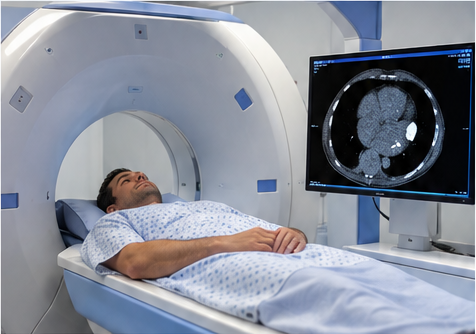
You feel fine. You have no chest pain, no shortness of breath, nothing out of the ordinary. But heart disease can build quietly for years, and by the time symptoms show up, the damage may already be well along.
What if a simple, 10-minute scan could show what’s happening inside your heart arteries long before that?
That is exactly what coronary artery calcium scoring does.
What Is Coronary Artery Calcium Scoring?
Coronary artery calcium (CAC) scoring is a quick, noninvasive heart scan that measures the amount of calcium buildup in the walls of your coronary arteries, the blood vessels that supply your heart.
Calcium deposits form as part of atherosclerosis, the gradual buildup of plaque that can eventually lead to heart attacks and strokes. By detecting this buildup early, often years or even decades before symptoms appear, a CAC score gives you and your doctor a direct window into the health of your heart arteries.
How Plaque Builds Up in Your Arteries
- Healthy artery.The artery wall is clear and blood flows freely.
- Early plaque buildup.Plaque begins to form along the artery wall.
- More plaque over time.The buildup grows and narrows the space for blood flow.
- Calcified plaque.Hardened, calcium-containing plaque forms, and this is what shows up on a CAC scan.
How Does the Test Work?
The scan is designed to be as easy as possible:
- Quick and easy.The entire process takes about 10 minutes, with the actual scan lasting roughly one minute.
- No injections.No contrast dye, no fasting, and no special preparation are needed.
- Low radiation.The radiation exposure is very low, comparable to a standard mammogram.
- A simple number.The scan produces a number called the Agatston score, which reflects the total amount of calcium detected across your coronary arteries. Your score is also compared to what is typical for others of your same age, sex, and ethnicity, giving your doctor additional context.
What Does Your Score Mean?
Your CAC score helps predict your risk of future heart disease and guides preventive treatment.
- Score of 0 (no detectable calcium).No calcium was found, which is associated with a very low risk of a heart attack over the next 5–15 years. In many cases, a score of zero allows your doctor to safely defer cholesterol-lowering medication, with a recheck in 3–7 years.
- Score of 1–99 (mild plaque buildup).Depending on your other risk factors, your doctor may recommend lifestyle changes and possibly medication.
- Score of 100–299 (moderate plaque buildup).Preventive treatment, including cholesterol-lowering medication and lifestyle modifications, is generally recommended.
- Score of 300 or higher (significant plaque buildup).Studies show that individuals with scores this high carry a cardiovascular risk similar to someone who has already had a heart attack. Aggressive preventive treatment is strongly recommended.
Why Does It Matter?
Standard cholesterol tests tell you about risk factors circulating in your blood, but they cannot tell you whether plaque has actually formed in your arteries. A CAC score bridges that gap.
It is one of the most powerful tools available for predicting future heart disease, often outperforming traditional risk calculators alone. For patients whose risk falls in a gray zone, not clearly low and not clearly high, a CAC score can be the deciding factor in whether to start preventive therapy or safely watch and wait.
The Bottom Line
Heart disease often develops silently, and the earlier you see it, the more options you have. A CAC scan is fast, painless, and requires no preparation, yet it can reveal what standard blood tests cannot.
Know more today for a healthier tomorrow.
Talk to your doctor about whether a coronary artery calcium scan is right for you.